
EGYPTIAN PYRAMIDS HISTORY
Pyramids of Giza: The only surviving Wonder of the Ancient World
The Egyptian pyramids stand as one of humanity’s greatest achievements. Built over 4,500 years ago, they were created as tombs for pharaohs, who believed they would become gods after death. Each pyramid was a sacred monument built to ensure the ruler’s safe passage to the afterlife and to honor their divine power on Earth.
Even after millennia of wind, earthquakes, and shifting sands, the pyramids of Giza remain standing. They are timeless reminders of the ancient Egyptians’ belief in eternity and their unmatched architectural skill.

From step tombs to true pyramids
The idea of building pyramids originated around 2700 BC with the Step Pyramid of Djoser in Saqqara. Designed by the architect Imhotep, it was the first large stone structure in history and marked the start of Egypt’s “pyramid age”. A few decades later, pharaohs like Sneferu experimented with designs at Meidum and Dahshur, building the Bent Pyramid and the Red Pyramid. These projects taught builders how to create the smooth, triangular shape we recognize today. Understanding this incredible historical evolution makes it even more fascinating when you finally step onto the plateau to visit the Pyramids of Giza.

The Pyramids of Giza – Egypt’s greatest achievement
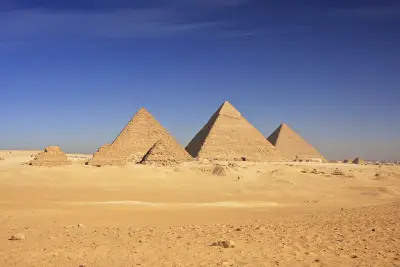
Around 2600–2500 BC, during the Fourth Dynasty, Egypt reached its peak in the pyramid-building era. On the Giza Plateau, near modern Cairo, three great pyramids were built for the pharaohs Khufu, Khafre, and Menkaure. The site also features the iconic Great Sphinx of Giza, carved beside the Pyramid of Khafre, as well as smaller pyramids for queens, mortuary and valley temples, long stone causeways, and vast ancient cemeteries where nobles and officials were buried. Archaeologists have also uncovered the remains of workers’ villages, boat pits that once held full-sized wooden ships, and chapels used for religious rituals. Together, these remarkable structures form the Giza Pyramid Complex – a UNESCO World Heritage Site that continues to fascinate visitors and researchers with its scale, craftsmanship, and enduring mystery.
Want to find out more about the Pyramids of Giza and their history?

Pick-up & drop-off
Pyramids Tour from Cairo
Book the Pyramids Tour from Cairo, and take a day trip to the pyramids of Ancient Egypt! We’ll pick you up at your hotel in Cairo or Giza, and then take you to the pyramids of Giza - one of the ancient Seven Wonders. Then you’ll visit the Great Sphinx, a massive sculpture of a lion with a man’s head. As you explore these monuments, your private guide will teach you about their history. Finally, enjoy a 10-minute camel ride before we drop you off at your hotel.

Pyramids of Giza & Great Sphinx access
Giza Pyramids Tickets
Step back in time and explore the last surviving wonder of the ancient world. Visit the Giza Pyramids, the Great Sphinx, and ancient tombs that tell Egypt’s 4,500-year-old story. You’ll be able to walk around the Great Pyramid of Khufu, Khafre, and Menkaure. See panoramic desert views, and uncover secrets of pharaohs and builders. Book your Giza Pyramids tickets today for an unforgettable journey through Egypt’s ancient past!

The Construction of the Pyramids
The pyramids were constructed during Egypt’s Old Kingdom period, roughly between 2600 and 2500 BC. They were built as royal tombs for the pharaohs Khufu, Khafre, and Menkaure, who ruled during the Fourth Dynasty. These kings believed their souls would ascend to the heavens to join the sun god Ra, so their tombs were built on the west bank of the Nile, symbolizing the land of the dead. Each pyramid took around 20 to 30 years to build, involving a workforce of 20,000 to 30,000 laborers. These workers were not slaves, but skilled Egyptians, including stonemasons, architects, laborers, and farmers, who worked during the flood season when farming was impossible. They lived in nearby workers’ villages, ate well, and received food, beer, and clothing as payment.

Building techniques and materials
Most pyramid blocks were made from limestone quarried nearby, while granite for the inner chambers came from Aswan, over 800 kilometers south. The stones were dragged on wooden sledges, with workers pouring water on the sand to reduce friction. Archaeological evidence suggests that ramps, possibly a combination of straight, spiral, and zigzag designs, were used to lift stones as construction progressed to higher levels. Copper chisels and dolerite pounding stones were used to shape the massive blocks. Inside, the pyramids contained burial chambers, passageways, and hidden shafts, all aligned with incredible precision to the cardinal points – north, south, east, and west.

Great Pyramid of Khufu (Cheops)
The Great Pyramid of Khufu at Giza, built around 2560 BC during Egypt’s Fourth Dynasty, is the largest in Egypt. Originally standing 146 meters tall (now 138 meters), it was once covered in smooth white limestone that made it gleam brilliantly under the desert sun. Built for Pharaoh Khufu, the pyramid took approximately 20 years to complete and required the labor of tens of thousands of skilled workers. Made from more than 2 million limestone blocks, it contains the King’s Chamber, Queen’s Chamber, and a network of narrow passages. For nearly 3,800 years, it held the title of the world’s tallest structure, standing as one of the greatest achievements in ancient engineering and a lasting symbol of Egypt’s power and craftsmanship.

Pyramid of Khafre (Chephren)
The Pyramid of Khafre, built around 2520 BC for Pharaoh Khafre, the son of Khufu, is the second largest pyramid on the Giza Plateau. Although slightly smaller than the Great Pyramid, it stands on higher ground, making it appear taller. Some of its original smooth white limestone casing still remains near the top, offering a rare glimpse of how all the pyramids once looked. Khafre’s pyramid complex also includes the Great Sphinx of Giza, a massive limestone statue with the body of a lion and a face believed to represent Khafre himself, guarding the plateau for over 4,000 years.

Pyramid of Menkaure
The Pyramid of Menkaure, built around 2490 BC for Pharaoh Menkaure, the son of Khafre, is the smallest of the three main pyramids at Giza, standing about 65 meters tall. What it lacks in size, it makes up for in detail; its lower section was once covered in pink granite, giving it a striking two-tone appearance. Beside it stand three smaller Queen’s Pyramids, built for royal women of the court. These smaller pyramids sometimes held not only queens but also royal daughters. Archaeological evidence suggests that Menkaure may have died before the pyramid was completed, and parts of it were likely finished by his successor. Despite its smaller scale, the pyramid and its surrounding complex remain an important part of the Giza Plateau’s timeless beauty and history.

The Great Sphinx
The Great Sphinx of Giza, with the body of a lion and the face of a king, has watched over the pyramids for thousands of years. Carved from a single block of limestone, it stands as one of the most recognizable monuments in the world. Its nose has been missing since at least the 15th century, while fragments of its royal beard are now kept in the British Museum and the Cairo Museum. For centuries, the Sphinx lay buried in sand up to its shoulders. Part of it was uncovered by Napoleon’s scholars in the early 1800s, but the full excavation took place between the 1920s and 1930s, revealing the magnificent statue we see today.

Valley temples and Causeways
Each of the Giza pyramids was connected to a valley temple by a long stone causeway used for religious ceremonies and the preparation of the pharaoh’s body. These temples played an important role in purification and mortuary rituals and offerings to the gods. The Valley Temple of Khafre is the best preserved, built from massive limestone and pink granite blocks, some weighing over 100 tons and transported from Aswan, nearly 800 kilometers away. Its structure and precise craftsmanship still impress visitors today, and parts of its original floor, where ancient rituals once took place, can still be seen.

Boat Pits of Khufu
Near the Great Pyramid of Khufu, you can see several long boat pits once used to bury the pharaoh’s “solar boats”, meant to carry him to the afterlife. With our Grand Egyptian Museum Tickets, you can see the famous Khufu Solar Boat. The Khufu Solar Boat is one of the best-preserved ancient boats in the world, discovered beside the Great Pyramid in 1954. It is over 43 meters long and made of cedar wood imported from Lebanon.
Tombs of nobles and workers’ village
Surrounding the pyramids are mastaba tombs built for nobles and high officials who served the pharaohs. Excavations have also uncovered the remains of a large workers’ village, complete with houses, bakeries, and breweries. These discoveries prove that the pyramid builders were not slaves, but skilled and paid laborers who lived in a well-organized community. Mud bricks were widely used as a building material for the surrounding settlements and later pyramid sites. The settlement provided food, shelter, and daily support for the thousands of workers who helped construct the pyramids, a remarkable example of planning and cooperation in ancient Egypt.

From Ancient Wonder to Modern Age
c. 2600–2500 BC – The Pyramid Age Begins
The pyramids of Khufu, Khafre, and Menkaure rise on the Giza Plateau. The Great Pyramid, standing 146 meters tall, becomes the tallest structure on Earth.
c. 2000 BC – The Middle Kingdom
Later pharaohs continued building pyramids, but on a smaller scale and with less durable materials, marking the decline of the grand pyramid era.
c. 1500–1000 BC – The New Kingdom
Egyptian rulers shift their burials to the Valley of the Kings in Luxor. The pyramids of Giza already stand as ancient monuments admired by later generations.
332 BC – 400 AD – Greek and Roman Periods
The pyramids attract travelers, historians, and scholars like Herodotus, who described them in detail.
12th–14th Centuries – The Middle Ages
Earthquakes damage the limestone casing, and many outer stones are reused to build mosques and palaces in Cairo.
1798 – Napoleon’s Expedition
Napoleon Bonaparte arrives in Egypt with scholars who study and document the pyramids in detail for the first time, sparking renewed global interest in ancient Egypt.
19th–20th Centuries – Archaeological Discoveries
Systematic excavations reveal workers’ villages, boat pits, and hidden chambers, deepening our understanding of how the pyramids were built.
21st Century – Modern Exploration
Today, advanced technology such as drones, 3D scanning, and thermal imaging continues to uncover new secrets within the pyramids, proving that even after 4,500 years, they still have stories to tell.

Legacy of the pyramids
After the Pyramid Age, later rulers continued building pyramids, but none ever matched the scale or precision of those at Giza. Over the centuries, earthquakes and stone removal stripped away their shining white limestone casing, leaving the rough surfaces we see today, yet their core structures still stand strong. The Great Pyramid of Giza, the only surviving Wonder of the Ancient World, remains a symbol of human skill, faith, and ambition.
Once gleaming across the desert like a beacon of eternity, it now welcomes millions of visitors each year who come to admire its timeless beauty and the mystery that has surrounded it for more than 4,500 years.
Explore Egyptian Pyramids with our bestselling tickets and guided tours!

Hotel pick-up & drop-off
Grand Egyptian Museum Tickets
Visit the world’s largest museum dedicated to one civilization. Explore over 100,000 ancient artifacts, like Tutankhamun’s treasures from 3,300 years ago. Stand beneath the 36-foot (11 meters) Ramses II statue from 1279 BC. Walk through 12 exhibition halls and see the Hanging Obelisk. You also get skip-the-line entry and a smooth ride straight to the museum. Book your Grand Egyptian Museum tickets and discover the wonders of ancient Egypt!

Giza, Sphinx & Memphis Tour
Memphis Tour Egypt
Explore the capital of Ancient Egypt with the Memphis Tour Egypt! We’ll pick you up in Cairo or Giza, and take you to the first Egyptian capital ever built. Your guide will then show you the rest of Memphis, including the Colossal Statue of Ramesses II. Finish the day trip with a visit to the pyramids of Giza, the Great Sphinx, and the Valley Temple. Once your tour guide has taken you through everything, we'll drop you off in Cairo or Giza.